Search Results for: cuban%20haitian%20entrants

Refine Results

FIRST PUBLISHED
RESOURCE TYPE
TOPIC
TARGET AUDIENCE
PUBLISHED BY
POPULATION
LANGUAGE

PUBLISHED BY:

Newcomer service providers in the U.S. face challenges in meeting the diverse needs of ORR-eligible populations, including when serving non-refugee groups such as Cuban and Haitian entrants (CHEs). These newcomers have different eligibility criteria compared to refugees. Service providers frequently report unmet client needs and service gaps, leading to confusion and frustration as they strive…

PUBLISHED BY:

Hosted on May 16, 2024 the training was delivered by Edith Tapia, Technical Advisor for Cross Border and Asylum at the International Rescue Committee. ​​The surge in asylum-seeking at the U.S. Southern Border arises from a myriad of challenges confronting Latin American and Caribbean nations, compelling more individuals to flee. Notably, significant numbers of people…

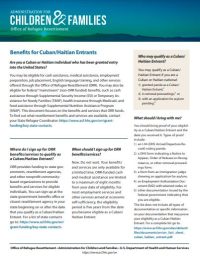
This information guide from the Office of Refugee Resettlement (ORR) answers questions about Cuban/Haitian Entrant benefits and services. Questions answered include: Who may qualify as a Cuban/Haitian entrant? Where do I sign up for ORR benefits/services to qualify as a Cuban/Haitian Entrant? When should I sign up for benefits? What should I bring with me?…

PUBLISHED BY:

Navigating changes in immigration and border policies over recent years has created a complex landscape for immigrants arriving through various points of entry, such as the southern border and airports. These individuals may require documentation from multiple government agencies, making it challenging to determine their legal status and eligibility for services such as ORR benefits…

PUBLISHED BY:

Are you seeking materials in Haitian Creole to support clients you serve? Based on requests from providers, this blog post compiles Haitian Creole language resources to help service providers and clients navigate three crucial areas: personal safety, workplace rights, and health care access. Most resources listed below are available in additional newcomer languages as well.…

This backgrounder provides information about recent Cuban history, current country conditions, displacement challenges, and the experiences of Cuban nationals in the United States and other parts of the Americas. It aims to help U.S. resettlement agencies (RAS), local affiliates, service providers, and practitioners better understand and support Cuban migrants, newcomers, and refugees in the United…

PUBLISHED BY:

Determining whether a potential client is eligible for Office of Refugee Resettlement (ORR)-funded services can sometimes be a challenge. This blog post gathers some key resources for service providers who are new to the work of navigating ORR eligibility requirements and documentation.Federal ResourcesClients with many different immigration statuses are eligible to participate in services from…

PUBLISHED BY:

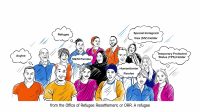
This animated video highlights the different humanitarian immigrant pathways that exist in the United States including categories like refugee, asylee, special immigrant visa holder, humanitarian parolees, Cuban/Haitian entrants, and temporary protected status. It provides a basic overview of the criteria that defines each category and acknowledges that each one has implications for receiving ORR benefits.…

PUBLISHED BY:

Across the United States, food insecurity is rising, and many low-income families, including refugees, asylees, and other Office of Refugee Resettlement (ORR)-eligible populations, are finding it harder to keep nutritious food on the table. According to the U.S. Department of Agriculture, in 2023, nearly 47 million people, including 7.2 million children, lived in households that…

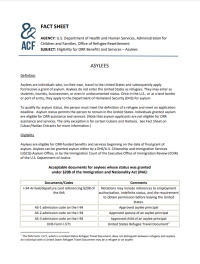
These fact sheets, developed by the Office of Refugee Resettlement, provide information on ORR eligibility for selected populations. These fact sheets include information on asylees, Cuban & Haitian entrants, refugees, special immigrant visa holders, survivors of torture, and victims of trafficking.