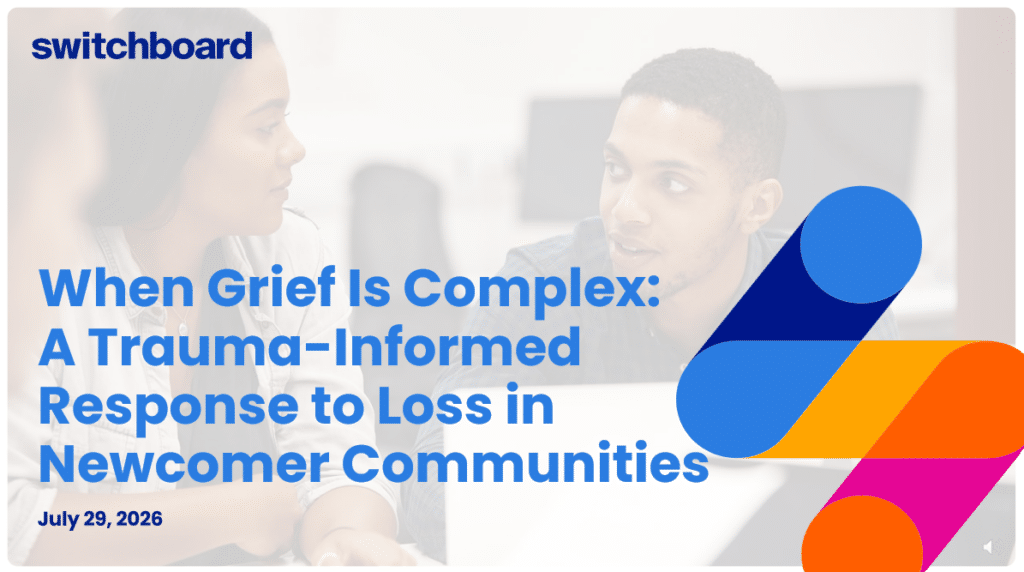
Hosted on July 29th, 2026, the training was delivered by Jasmine Griffin, MA, LPC, Training Officer, Switchboard, and Kristen L. Guskovict, MS, LCSW, Independent Consultant
Webinar Overview
People resettling to the United States often face grief and loss at multiple points along their journey. In the most serious cases, this includes the death of loved ones. But loss also comes in many other forms—leaving behind one’s country, community, and familiar ways of life, as well as separation from family. These layers of grief often build on top of the everyday stresses of adapting to a new country, creating feelings that can be complex and overwhelming. Supporting newcomers through this kind of grief can be challenging in several ways. Service providers may be unsure how to comfort grieving clients, especially those who express grief and loss in unexpected ways. Providers may also feel uncertain about what their role should be, as grief support is not a formal part of resettlement services. Additionally, providers have to simultaneously navigate their own emotional responses.
This webinar offers service providers and their managers a deeper look at grief and loss in the context of resettlement. Participants will explore the connection between grief and trauma, examine common responses to loss, and consider how trauma-informed care can support culturally responsive practice. Through practical examples and reflection,
participants will build confidence and develop concrete strategies for supporting clients experiencing grief and loss, while also recognizing the impact on themselves.
What I Will Learn
After watching this webinar recording, you will be able to:
- Explain the relationship between grief, trauma, and traumatic grief in newcomer populations
- Identify common physical, emotional, behavioral, and spiritual expressions of grief that may be experienced
across cultures - Describe how cultural beliefs, migration experiences, and systemic barriers can influence how newcomers
experience and express grief - Apply trauma-informed and culturally responsive strategies to support individuals experiencing grief and loss
while recognizing the impact on providers
Who Will Benefit?
- Direct service providers utilizing trauma-informed care in their work with newcomer populations
- Supervisors or managers supporting direct service providers who serve newcomer populations
Level
- Intermediate