FILES


Do trauma-informed school practices lead to improved mental health and academic outcomes in children?

M&E | Track Resource Download

SHARE

Do trauma-informed school practices lead to improved mental health and academic outcomes in children?

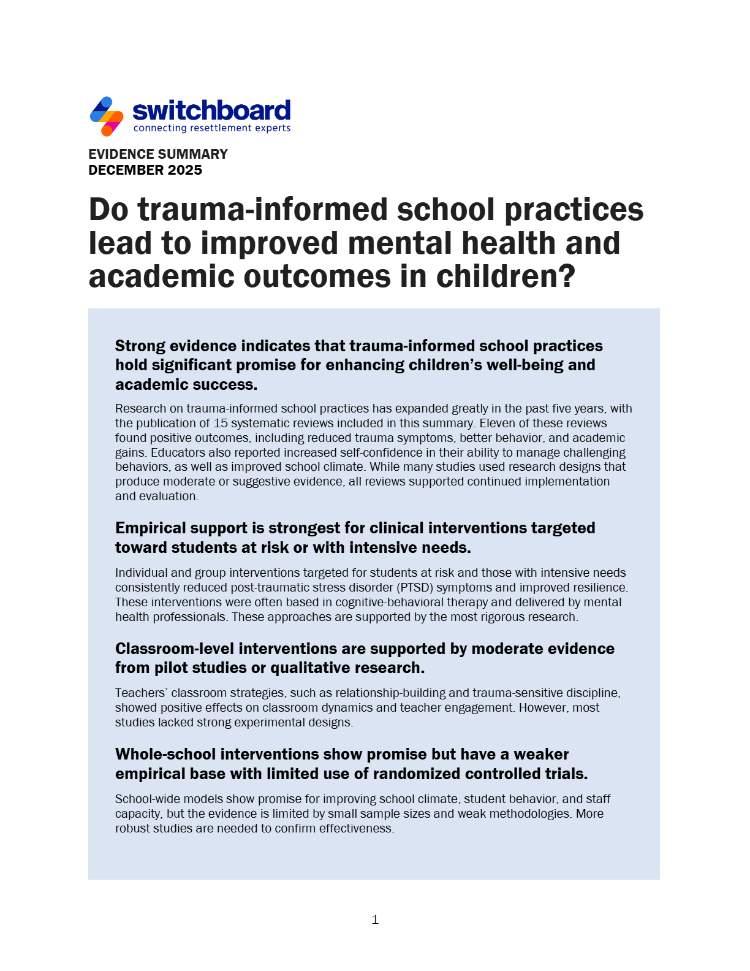
Strong evidence indicates that trauma-informed school practices hold significant promise for enhancing children’s well-being and academic success.

Research on trauma-informed school practices has expanded greatly in the past five years, with the publication of 15 systematic reviews included in this summary. Eleven of these reviews found positive outcomes, including reduced trauma symptoms, better behavior, and academic gains. Educators also reported increased self-confidence in their ability to manage challenging behaviors, as well as improved school climate. While many studies used research designs that produce moderate or suggestive evidence, all reviews supported continued implementation and evaluation.

Empirical support is strongest for clinical interventions targeted toward students at risk or with intensive needs.

Individual and group interventions targeted for students at risk and those with intensive needs consistently reduced post-traumatic stress disorder (PTSD) symptoms and improved resilience. These interventions were often based in cognitive-behavioral therapy and delivered by mental health professionals. These approaches are supported by the most rigorous research.

Classroom-level interventions are supported by moderate evidence from pilot studies or qualitative research.

Teachers’ classroom strategies, such as relationship-building and trauma-sensitive discipline, showed positive effects on classroom dynamics and teacher engagement. However, most studies lacked strong experimental designs.

Whole-school interventions show promise but have a weaker empirical base with limited use of randomized controlled trials.

School-wide models show promise for improving school climate, student behavior, and staff capacity, but the evidence is limited by small sample sizes and weak methodologies. More robust studies are needed to confirm effectiveness.

Post TitleStrength of EvidenceType of StudyDirection of Evidence
Triple Disadvantage? A first overview of the integration of refugee womenSuggestiveSuggestive evidencePositive impact
Syrian women refugees in Jordan: opportunity in the gig economySuggestiveSuggestive evidenceInconclusive or mixed impact
Interventions to Improve the Economic Self-sufficiency and Well-being of Resettled Refugees: A Systematic ReviewStrongSystematic reviewInconclusive or mixed impact
Integrating refugees into host country labor markets: Challenges and policy options.SuggestiveSuggestive evidenceInconclusive or mixed impact
Which Employment Strategies Work for Whom? A Meta-RegressionStrongSystematic reviewPositive impact
Evaluating Foreign Skills: Effects of Credential Assessment on Skilled Immigrants’ Labour Market Performance in CanadaSuggestiveSuggestive evidencePositive impact
Extended Case Management Services Among Resettled Refugees in the United StatesModerateImpact evaluationPositive impact
Labor market effects of a work-first policy for refugeesSuggestiveSuggestive evidenceInconclusive or mixed impact
The Long-term Economic Outcomes of Refugee Private SponsorshipSuggestiveSuggestive evidencePositive impact

Websites and Databases Population Terms Methodology Terms Target Intervention Terms
Campbell Collaboration

Cochrane Collaboration

Mathematica Policy Research

Evidence Aid

Urban Institute

Migration Policy Institute

HHS OPRE

ASSIA

Social Services Abstracts

Social Work Abstracts

ReliefWeb

Sociological Abstracts

Policy File Index

PAIS

GenderWatch

refugee

OR

asylee

OR

T-Visa

OR

U-Visa

OR

Cuban

OR

Haitian

OR

Amerasian

OR

immigrant

OR

low English proficien*


evaluation

OR

impact

OR

program

OR

intervention

OR

policy

OR

project

OR

train*

OR

therapy

OR

treatment

OR

counseling

OR

workshop

OR

review

OR

meta-analysis

OR

synthesis

(women or female)

OR
employ*

OR

“job readiness”

OR

work

OR

“self-sufficien*”

OR

“workforce development”

OR

“job development”

OR

“career”