
Each resettlement journey is unique, and clients arrive with different expectations about life in the United States. When those expectations don’t align with reality, clients can become confused and frustrated. If you serve newcomers through the Program of Initial Resettlement (PIR), you may have faced this challenge. Since PIR began in January 2026, providers have asked Switchboard for advice on how to respond. This blog post answers your most common questions, with tips you can try today.
Client Expectations
How do I help newly arriving refugees have more realistic expectations?
Mismatched expectations can often lead to challenging client conversations. You can:
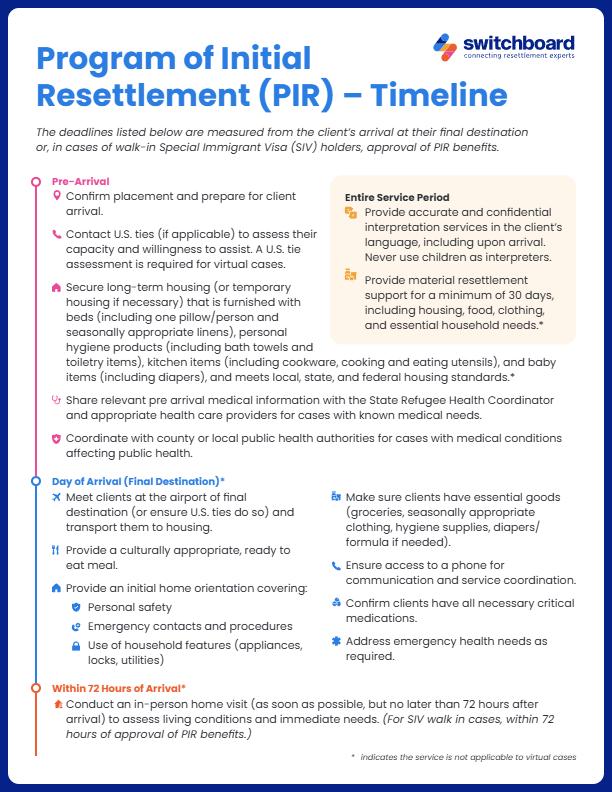
- Explain PIR services and timelines for PIR service delivery upfront, including how long services are available and any known service delays (e.g., Social Security cards).
- Share when clients can reach you during business hours and your typical response timeframe for calls, texts, emails, etc.
- Inform clients about what to do in case of an emergency and emphasize that you are not the right contact person for emergencies.
- Identify with the client which resettlement tasks require caseworker involvement.
- Clearly state what is available and possible during the Program of Initial Resettlement (PIR) service period.
What should I do when a client believes they are automatically entitled to benefits and declines to provide needed eligibility documentation?
Some refugees may see their status as a guarantee of benefits and not realize they must demonstrate eligibility for programs and services after arrival. You can:
- Review your client rights and responsibilities policy early, including the responsibility to provide information needed for benefit applications.
- Walk through what each application asks for and what each document proves, such as identity, immigration status and date of entry, income, household size or address.
- Share that under ORR’s Status and Documentation Requirements, individuals must provide acceptable documentation of a status eligible for ORR benefits. More than one document may be needed to confirm status, identity and entry date.
- For mainstream benefits, let clients know that everyone who applies, including U.S. citizens, is asked to provide documentation. The documentation requirements vary by state.
- Be clear about what happens if documents aren’t provided: the benefits agency can’t complete its review, and the application will likely be denied.
- Acknowledge that some clients may be wary of sharing documents or personal information due to distrust of government. Help clients distinguish between trustworthy and untrustworthy requests. Consider sharing Settle In’s Common Signs of Identity Theft.
How can I build trust-based relationships with the clients I serve?
A strong client-caseworker relationship supports a productive PIR service period. Take time to build rapport with clients:
- Greet clients with a handshake, if culturally appropriate, and address them by name; if you are unsure how to correctly pronounce someone’s name, ask them.
- Actively listen to clients and reflect their concerns in your responses.
- Ask open-ended questions, especially when discussing sensitive topics.
- Communicate consistently so clients understand what to expect next. There is no set requirement for ongoing communication with PIR clients; communication should be regular enough that both you and the client are well-informed. One way to manage communication is to share at the end of each conversation when and how the client will hear from you next (e.g., call, text, email, in-person meeting).
Tip: Build cultural orientation messaging into your regular communication throughout the service period. For example, when assisting a family with school enrollment, you can share information about the benefits of school enrollment and what “timely enrollment” means so the family understands why this service should happen within 30 days of arrival.
Direct Assistance
How can I help clients understand that some of their direct assistance (DA) was spent before their arrival and they will not receive the entire amount in cash?
Under PIR, financial support for each client helps meet basic needs like rent, food, and utilities. Direct assistance can confuse newcomers if they aren’t aware of its purposes. You will likely have spent some of the client’s direct assistance on things like rent, personal care items, and initial food before their arrival. The amount of direct assistance varies by family size; you may pay the client directly, or more commonly, pay vendors on a client’s behalf for basic needs.
Explain this to the client when you meet, and let them know they should not expect the entire amount of direct assistance in cash. In fact, they may not receive any funds directly except for their pocket cash. Reassure the client that:
- All direct assistance is used for their benefit.
- They will receive a statement showing how all their direct assistance is used.
- They will sign an acknowledgment for each expense to confirm the direct assistance was used in support of their basic needs.
How can I help clients understand the limits of their direct assistance and prepare for managing their household finances once the PIR service period is over?
A household budget is the most helpful tool for helping clients see where their money goes, whether they need to supplement their income or can save, and what their expenses will be once the PIR service period ends. Developing the budget early in the service period can help demonstrate what direct assistance can cover and reinforce early self-sufficiency through employment as a key to resettlement success.
Housing
How can I help clients understand leases?
Housing is different throughout the world, and some clients may not be familiar with leases. They may also be concerned that signing a lease locks them into a housing situation they do not love. You can:
- Provide a general overview of housing in the U.S.
- Explain that the lease outlines the things the landlord and tenant agree to do and provides protections for the tenant.
- Share that some landlords may offer shorter-term leases (e.g., six months), but those leases are often at a higher rental rate, which may not be reasonable during the PIR period.
- Inform clients that breaking a lease can be expensive, so they should fully understand all the terms and their commitment before signing.
Are you looking for multilingual, newcomer-facing resources to share with your clients about housing? Find information about leases, renting in the U.S., and more at Settle In.
What should I do when a client is unhappy with their housing?
When a client voices housing preferences that are unrealistic in their current situation, a move to housing that meets their expectations may not be possible. Rental rates, housing vacancies, and the type of available housing (e.g., apartments, free-standing single-family houses, housing on large pieces of land) all impact where newcomers are likely to reside.
First, acknowledge the client’s frustration so they feel heard. Next, share any or all of the following facts to help manage their expectations and look toward the future:
- Their first home in the U.S. is unlikely to be their long-term housing in the U.S.
- Building a strong rental history can help them build their credit and reach their housing goals in the future.
- With an established rental history and additional income, they will likely have more choices for their next home.
- Multigenerational housing, gated communities, and metal bars on doors and windows are all uncommon in the U.S. Locks on doors and windows are the most common way to keep a house secure.
Additional PIR Resources
Switchboard has developed PIR-focused resources to support your understanding of the program and your work, including:
- Understanding the Program of Initial Resettlement: An Overview of Program Requirements to Support Service Delivery for New Arrivals
- Getting Started with the Program of Initial Resettlement: Pre-Arrival
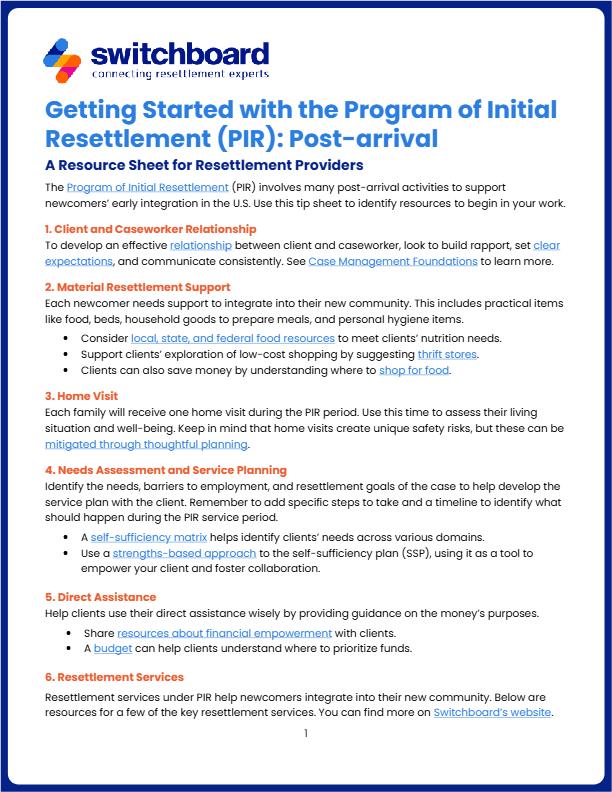
- Getting Started with the Program of Initial Resettlement: Post-Arrival
- Best Practices in Program of Initial Resettlement Implementation
Be on the lookout for more PIR content from Switchboard in the coming months!
The IRC received competitive funding through the U.S. Department of Health and Human Services, Administration for Children and Families, Grant #90RB0053. The project is 100% financed by federal funds. The contents of this document are solely the responsibility of the authors and do not necessarily represent the official views of the U.S. Department of Health and Human Services, Administration for Children and Families.