
Collecting high-quality data is essential in refugee service work, whether for client needs assessments, program evaluations, or organizational learning. But sometimes even well-intentioned surveys can unintentionally create stress, reduce trust, or compromise the accuracy of the data collected.
Switchboard’s Trauma-Informed Survey Toolkit (TIST) was developed to help service providers design surveys that are safe, respectful, and effective. This blog post introduces the TIST and walks through its guidance on how to apply trauma-informed principles across the four phases of surveys: Design, Implementation, Analysis, and Dissemination.
Why Trauma-Informed Surveys Matter
Many newcomers have experienced displacement, violence, and chronic stress. Trauma-informed survey design applies the six principles of trauma-informed practice—safety; trustworthiness and transparency; peer support; collaboration and mutuality; empowerment, voice, and choice; and cultural, historical, and gender issues—to encourage data collection that:
- Protects participants’ psychological and physical safety
- Builds trust and transparency
- Reduces the risk of re-traumatization
- Improves data quality by minimizing avoidance, dropout, or distress
- Supports fair, cross-cultural evaluation practices
— Switchboard’s Trauma-Informed Survey Toolkit
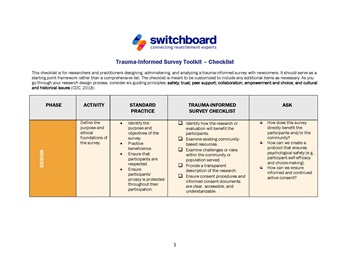
The TIST offers practical steps, useful prompts, and reflective questions to help you apply these principles in day-to-day work, along with a checklist to illustrate how the TIST extends beyond standard good practices in survey design. This toolkit can be used by organizations of all sizes and by service providers with all levels of experience and in a wide variety of positions within organizations, from caseworkers to monitoring and evaluation (M&E) specialists.
So, let’s dive in to learn more about how the TIST can help inform your survey work!
Phase 1: Design
Strong trauma-informed surveys begin long before data collection. When considering the design phase, the TIST encourages practitioners to think of not only what information is being collected, but how and why, ensuring that planning is grounded in safety, ethics, and participant-centered design.
The TIST walks through six components of survey design:
- Define the Purpose and Ethical Foundations of the Survey: Clarify why you’re collecting data and how it will benefit the people you serve. Use the prompts to reflect on potential risks, strengthen your consent process, and communicate clearly about how the information will be used.
- Establish a Team and Develop a Workplan: Identify who should be involved in survey design, including community members and people with lived experience. Use the reflective questions to determine roles, surface power dynamics, and build a collaborative plan.
- Select a Survey Design and Draft Questions: Choose a survey structure that reduces burden and supports safety. Sample prompts help you refine questions, incorporate community feedback, and plan for content warnings or sequencing.
- Identify the Target Population and Sampling Strategy: Carefully evaluate who is included and who may be unintentionally excluded. Use the reflective questions to check for equal access, transparency, and participant safety in your sampling approach.
- Establish Data Security and Management Protocols: Outline how to collect only essential data, minimize identifiers, store it securely, and communicate transparently to participants how the data will be used, shared, and protected.
- Select Administration Modalities and Design a Survey Protocol: Determine whether your survey should be self-administered or enumerator-administered. Use the questions to assess accessibility, plan for participant choice, and create a protocol for responding to distress.
Phase 2: Implementation
The implementation stage focuses on how the survey is carried out in practice using a trauma-informed lens. This includes creating predictable processes, setting safe and comfortable environments, and ensuring that staff are prepared to respond in trauma-informed ways.
- Implement the Survey: Ensure your administration process is predictable, safe, and participant-centered. Use the prompts to confirm that staff are trained, participants can pause or opt out, and the environment supports comfort.
- Follow-Up with Participants: Close the loop with participants respectfully. Follow the prompts to help plan how to thank participants, share next steps, offer resources, and invite feedback when appropriate.
Phase 3: Analysis
- Conduct Data Analysis: Interpret the data in ways that avoid pathologizing responses (i.e., labeling behaviors or responses as abnormal or problematic) and that account for how trauma may shape engagement. Use this section to integrate participant and community perspectives into your analysis, perhaps by soliciting feedback on what analyses would be more useful to meet community needs.
Phase 4: Dissemination
- Share Out the Findings: This step encourages sharing results in accessible, culturally relevant ways, including using strengths-based frames that avoid stigmatizing responses or using deficit-focused narratives. The prompts guide you to assess tone, encourage community input, consider community relevance, and maximize having the data meaningfully benefit the people who contributed it.
Conclusion
Trauma-informed approaches remind us that data collection is not just about gathering information but also about building relationships rooted in trust and care. By drawing upon the steps and reflective questions outlined in the Trauma-Informed Survey Toolkit, you can design processes that honor participants’ autonomy and experiences while meeting program needs. As you move forward, consider how each survey interaction can be an opportunity to strengthen connection, promote safety, and elevate newcomer community voices.
Learn More
- Trauma‑Informed Survey Toolkit: Switchboard’s toolkit that provides practical guidance for practitioners and researchers who want to conduct surveys using trauma-informed principles.
- Housing Needs Assessment Guide for Refugee Resettlement Agencies in the U.S.: A template from Switchboard and Refugee Housing Solutions (RHS) designed to evaluate the housing needs of newcomers in the U.S.
- Federal Data Resources for Planning Refugee Services and Consultations: A Switchboard template that highlights how effective data-sharing can strengthen connections and coordination between newcomer-serving organizations and agencies.
- Measures that are Appropriate for Refugee Children and Families: A toolkit from the National Child Traumatic Stress Network (NCTSN) that provides survey tools to assess issues that refugee children and families face.
- A Discussion on Refugee Mental Health: A Switchboard podcast discussing ways to support newcomers with a trauma-informed lens.
- Planning Effective Surveys with Newcomers: A Switchboard information guide offering tips for planning and administering surveys with newcomer clients.
- Collecting Client Feedback Data: A Switchboard information guide with background information and recommendations regarding ethical feedback collection and selecting appropriate methods.
The IRC received competitive funding through the U.S. Department of Health and Human Services, Administration for Children and Families, Grant #90RB0053. The project is 100% financed by federal funds. The contents of this document are solely the responsibility of the authors and do not necessarily represent the official views of the U.S. Department of Health and Human Services, Administration for Children and Families.