This blog post describes innovations potentially relevant to service providers that were shared at the 2026 International Refugee and Migration Health Conference, held annually by the Society of Refugee Healthcare Providers. Formerly the North American Refugee Health Conference, it draws providers, researchers, policymakers, and advocates working in refugee and immigrant health to share the latest best practices.
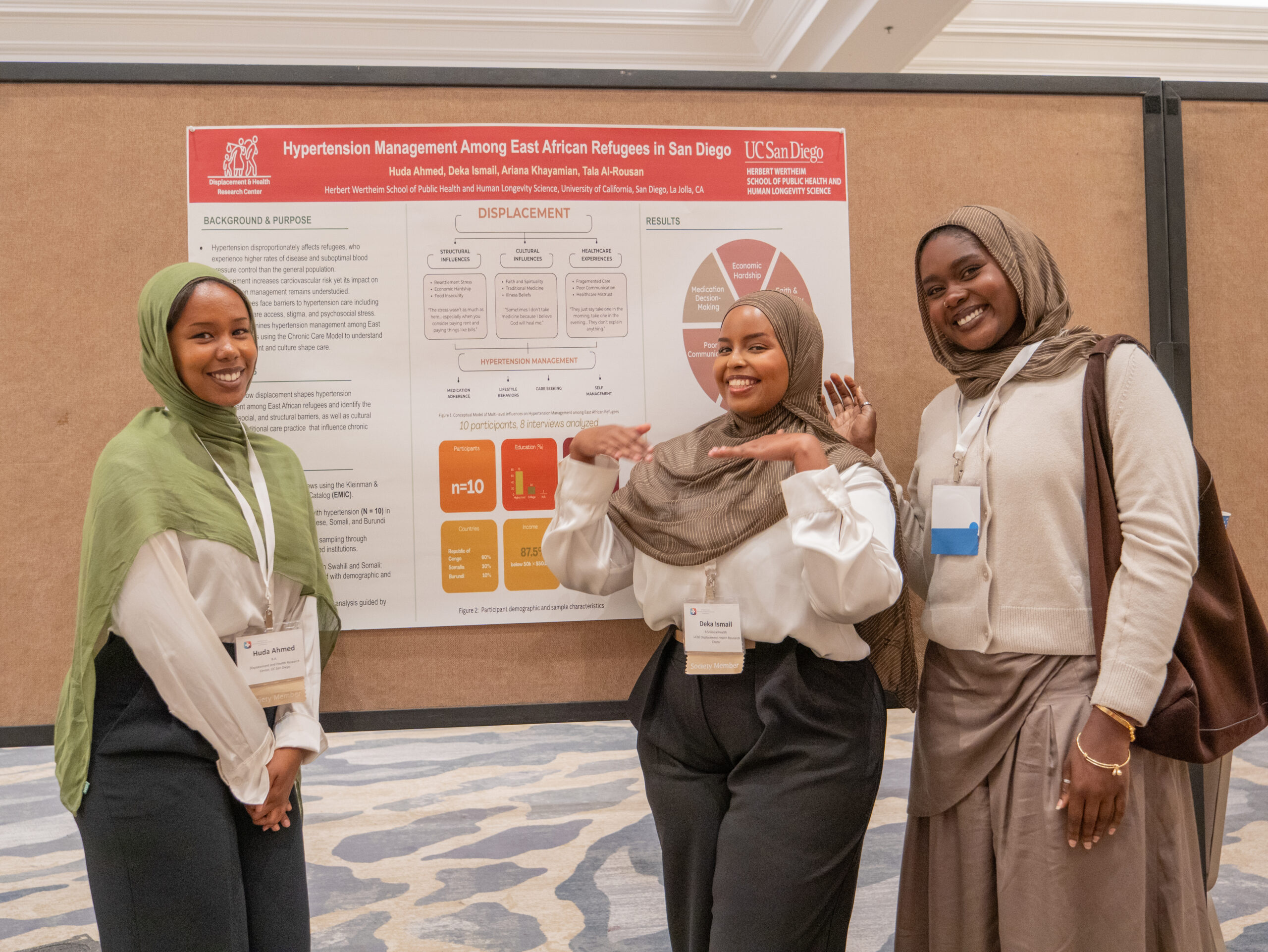
Innovation in refugee health was on display at the Society of Refugee Healthcare Providers’ 2026 International Refugee and Migration Health Conference (IRMHC) this past June. Over 680 people gathered in San Diego, California, to present their latest research and programming. Below we share some of the highlights most relevant to refugee service providers, even if health isn’t your focus area.
The Promises and Limitations of Artificial Intelligence (AI) in Resettlement
Ambient AI Scribes: Help or Harm?
Some organizations are grappling with whether to introduce AI at all, given its ethical, privacy, and environmental implications. Others have seen it embedded institutionally and must now consider how they will work with it. Ambient AI scribe technology is a documentation tool that some health institutions use to record, transcribe, and analyze patient-provider interactions and generate clinical notes, which are then inputted into patients’ electronic health records. Through a workshop offered by clinical experts from a range of leading institutions, IRMHC attendees explored the ethics of its now-prevalent usage in the clinic setting.
Health care providers increasingly spend the majority of their time on charting rather than patient care, with some reporting 6.5 of every 8 hours devoted to charting. Ambient AI scribes offer a solution. The AI tool records and transcribes the patient-provider encounter and then generates a summary for the provider to edit. There are limitations, however. Ambient AI scribes can:
- Fail to accurately recognize speech
- Omit key details
- List incorrect diagnoses or medications
- Include inaccuracies or make up details that can have significant consequences for understanding a person’s health
These concerns about AI scribes are relevant not only in health care but also in resettlement and community-based settings. As funders require detailed documentation of efforts and as staff are cut, those outside of health care may be considering or already using AI scribes. If you are considering using an AI scribe as a refugee service provider, you must ensure that:
- Your organization has a policy related to AI usage, specifically the use of ambient AI scribes, that outlines how to obtain informed consent (in keeping with any applicable state laws), confidentiality, and storage. If your organization does not have such a policy, work with your management team to create one.
- You have obtained meaningful informed consent from each individual in the room, including clients, interpreters (who are often overlooked regarding consent), and anyone else in the room
- You have a process for checking and confirming that any notes the AI scribe takes are accurate
Alma, a Client Co-Designed Virtual Case Manager
A presentation from the International Rescue Committee (IRC) showcased what AI can do for the public good through Alma, a virtual case manager chatbot available in Dari/Farsi, English, Spanish, and Swahili. The IRC co-designed Alma via focus groups and usability testing with 20 newcomer clients of different backgrounds. Launched in October 2025, Alma is the first of its kind. It provides information on a range of issues relevant to refugees and newcomers, leveraging decades of IRC expertise and community resources from 30 IRC offices as well as Settle In.
Ethical design is at the core of Alma and includes client co-design, safety guardrails for high-risk topics, and continuous user feedback. Importantly, given the limitations of AI, the tool is designed to work seamlessly with humans through escalation to live support where appropriate.
Presenters noted that since launching, Alma has engaged approximately 1,000 unique users across the United States, with average engagement of 18 minutes and a 4.7-star rating. Usage data and testing indicated strong demand for housing support, food access, public benefits navigation, community resources, and health navigation, including locating health care providers and understanding benefits eligibility.
To learn more about using AI with newcomers, see the below resources from Switchboard:
- Talking with Newcomers about Artificial Intelligence (AI)
- Getting Started with Artificial Intelligence: Part I, FAQs and Part II, Tools to Try in Your Work
- Using Artificial Intelligence in Service Delivery: A Framework to Evaluate Organizational Readiness
Need a client-facing resource? See Settle In’s Understanding Artificial Intelligence, available in eleven languages!
Sustaining the Work Through Coalition Building
In a time of scarcity and funding cuts, it can be tempting to take the approach of “each organization for itself.” A plenary presentation from the San Diego Refugee Communities Coalition (SDRCC) was a refreshing antidote.
SDRCC uses a collaborative structure that supports refugee communities through coordinated services, trusted messengers, data ownership, and an innovative funding model that strengthens both community partners and funders. A coalition of 12 ethnic community-based organizations (ECBOs), SDRCC leverages sub-agreements to deliver coordinated action. Its staffing reflects the communities it serves:
- Staff speak 18 languages, and 67% of staff speak three or more
- All staff are refugees, immigrants, and/or asylum seekers
- Staff range in age from 19 to 64 years old
Through shared leadership, coordination, and program managers, SDRCC has a robust structure in place to align partners on budgets, goals, programming, and reporting. They successfully model a critical mindset shift toward sustaining the work together amid hardship.
To connect with ECBOs in your area, access Switchboard’s National ECBO Directory, created in partnership with Karen Organization of San Diego.
Using Simulation and Virtual Reality to Rehearse Real-Life Encounters
IRMHC presentations highlighted various ways to use simulations and virtual reality (VR) to educate providers and clients. One focused on a simulation for internal medicine trainees to identify and manage a serious, potentially life-threatening health condition using a virtual interpreter to communicate with a patient whose preferred language was not English. Participants reported that the simulation felt authentic and that it improved their confidence in providing culturally competent care and adopting best practices when working with interpreters.
Another presentation showcased Switchboard’s 360° virtual reality (VR) initiative. Newcomers wear VR headsets to watch and interact with 360° videos of common scenarios before encountering them in real life, such as navigating health care in the U.S. Switchboard shared with IRMHC attendees how they applied co-creation with six agencies, where newcomers served as script developers, actors, and cultural advisors on scenarios covering ride-share, pharmacy, and clinic navigation. After VR exposure, 91% of participants reported that they could visualize real-life health care experiences.
IRMHC attendees had the opportunity to try out the VR themselves, with guided reflection from the presenters. They drafted their own health care scenarios and then examined the logistics of creating VR in terms of hardware, funding, producing multilingual content, and measuring outcomes.
IRMHC looks forward to welcoming people back June 28–30, 2027, in Montréal, Canada, to hear where these learnings have sparked innovations of their own.
See more Switchboard resources on using VR in your work:
- Switchboard: Going to the Pharmacy Virtual Reality 360 Video
- Switchboard: How 360° VR Videos Are Transforming Refugee Resettlement
The IRC received competitive funding through the U.S. Department of Health and Human Services, Administration for Children and Families, Grant #90RB0053. The project is 100% financed by federal funds. The contents of this document are solely the responsibility of the authors and do not necessarily represent the official views of the U.S. Department of Health and Human Services, Administration for Children and Families.