
Affordable housing programs in the United States can be complex, especially for staff who support newcomers navigating these systems for the first time. This blog post provides an overview of key affordable housing programs, terminology, and eligibility requirements. Although every community operates differently, these concepts will help you assess client eligibility, make informed referrals, and build partnerships with local housing providers so you can guide clients toward housing programs that will best meet their needs.
Key Agencies and Concepts
Before exploring specific programs, it is important to understand the core agencies and concepts used across affordable housing systems in the United States.
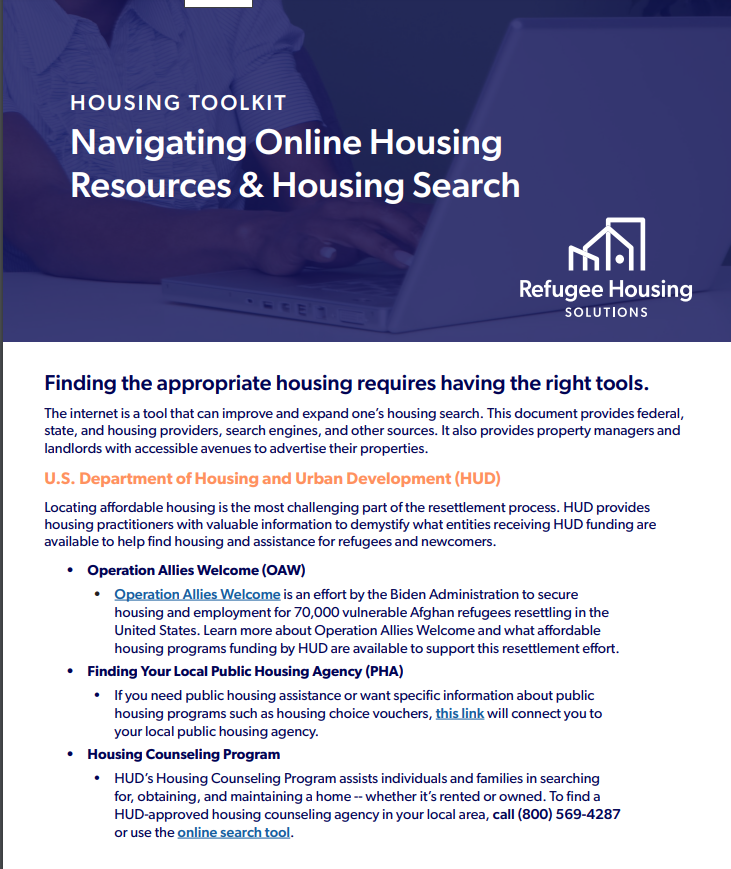
U.S. Department of Housing and Urban Development (HUD)
The U.S. Department of Housing and Urban Development (HUD) is the federal agency responsible for national housing policies and administering most federally funded affordable housing programs. HUD defines affordable housing as housing in which the occupant is paying no more than 30% of the household’s income toward their housing costs (rent and utilities). HUD has many programs serving both individuals and families with low incomes, and each program has its own eligibility rules. However, applicants do not directly apply to these programs with HUD but rather through local agencies, which we will describe below.
HUD affordable housing programs are currently available to all of the following statuses:
- U.S. citizen
- Lawful permanent resident
- Asylee
- Refugee
- Noncitizens paroled in the U.S. for at least one year
- Certain human trafficking victims and family members
- Noncitizens granted withholding of removal under 8 U.S.C. section 1231(b)(3)
A mixed status household may still be eligible, but the level of assistance will be prorated, and those households should weigh the risks and benefits before applying.
Public Housing Agencies (PHAs)
Public Housing Agencies (PHAs) administer HUD programs at the local level. HUD funding is given to state and local agencies to operate these programs. PHAs:
- Manage public housing units
- Process applications for Housing Choice Vouchers
- Determine eligibility and maintain waitlists
- Set local preferences and policies
PHA preferences and eligibility requirements vary by location. It is best to become familiar with the local PHA in your service area using the HUD PHA Search Tool.
Continuum of Care (CoC)
The Continuum of Care (CoC) Program supports individuals and families (including unaccompanied minors) experiencing homelessness by providing community planning, strategic coordination and delivery of resources, and data collection/measurement. Each community tailors its programs to its own strengths and challenges. CoCs:
- Manage the Coordinated Entry System (CES) (see below)
- Oversee homeless service programs
- Help place clients into transitional or permanent housing
- Partner with agencies to address gaps in services
Agencies working with eligible newcomer populations are encouraged to partner with or become members of their local CoC. To find out more about the CoC Program or search for a local CoC, explore the CoC Program on HUD Exchange.
Coordinated Entry System (CES)
A Coordinated Entry System (CES) is an evidence-based system that helps people experiencing a housing crisis have fair access to the housing and homeless assistance resources they need. It allows the community to quickly identify, assess, and connect those needing services to financial/rental assistance, voluntary supportive services, or other services based upon their self-identified needs.
Contact your local CoC Program to learn more about the Coordinated Entry System in your service area.
Area Median Income (AMI) and Income Limits
Area Median Income (AMI) is the median (midpoint) income of a given region, broken down by county or metropolitan area. HUD uses AMI to set Income Limits, which vary by household size and determine program eligibility. The three Income Limits brackets are as follows:
- Low-income households = 80% or less of AMI
- Very low-income households = 50% or less of AMI
- Extremely low-income households = 30% or less of AMI
Most HUD programs prioritize extremely low-income households. Explore your service location’s income limits with HUD’s Income Limits dataset.
Fair Market Rents (FMRs)
Fair Market Rents (FMRs) are HUD’s estimate of standard rent amounts for a given area. In affordable housing, FMRs help determine:
- Payment standards for voucher programs
- Reasonable rent levels for subsidized housing
- How much assistance a household may receive
The FMRs are updated annually. Search FMRs in your service area via HUD’s Fair Market Rents Portal.
The Housing Choice Voucher (HCV) Program
The Housing Choice Voucher (HCV) program (also known as Section 8) is one of the largest affordable housing initiatives in the U.S. HCVs provide partial rent payments that can be used in any unit where the landlord accepts vouchers. PHAs must provide
75% of their vouchers to extremely low-income households. The remaining 25% of HCVs are usually focused on very low-income households.
What HCVs Provide
- Partial assistance toward monthly rent
- Flexibility to rent units in the private market
- Portability between jurisdictions (for most vouchers)
Types of Vouchers
- Tenant-Based Vouchers (TBVs): The most common voucher type. Assistance follows the household, even if they move.
- Project-Based Vouchers (PBVs): The voucher is attached to specific units within designated developments. Households must live in those units to receive assistance.
Eligibility Considerations
- Household income (usually extremely low- or very low-income) using local HUD income limits
- S. citizens or eligible immigration status (see above)
- Valid Social Security numbers for household members
- Background checks (certain criminal convictions may affect eligibility)
It is recommended to apply for vouchers early in the process. For example, a new refugee arrival should apply as soon as they have a Social Security number, even if there are long waitlists for HCVs in your region. Agencies should also work with their local PHAs to establish preferences for one or more immigration statuses, such as refugees. HUD allows these preferences if they are not based on national origin but rather open to all members of that immigration status.
Emergency Housing Vouchers (EHVs)
Emergency Housing Vouchers (EHVs) support individuals and families facing severe housing instability. The EHV program works with PHAs, CoCs, and Victim Service Providers to provide tenant-based voucher assistance for those most in need.
Eligibility
Referrals must come through the local CoC’s Coordinated Entry System (CES) or directly from partners and must meet at least one of the following criteria:
- Currently homeless
- At risk of homelessness
- Fleeing or attempting to flee domestic violence, dating violence, stalking, sexual assault, or trafficking
- Recently homeless and at high risk of housing instability
EHVs may be a good choice for homeless or high-risk newcomers. For example, a newcomer enrolled in an intensive case management (ICM) program that is being evicted should be referred to the local CoC and its partners.
Public Housing
Public housing provides subsidized rental units that are owned and managed by local PHAs. They vary in type and size from single family homes to high-rise apartments.
Key Features of Public Housing
- Rents are income-based
- Designed for low-income families, elderly individuals, and people with disabilities
Eligibility
- Low-, very low-, or extremely low-income individuals or families
- S. citizenship or eligible immigration status
- PHA may have elderly or disability preferences for public housing
Waitlists and the Application Process
Most affordable housing programs maintain waitlists due to the high level of demand. Eligible applicants may join any open waitlists, even outside of their immediate area.
Key Points
- PHAs must offer to place eligible applicants on all open waitlists for which they qualify
- Households may apply to any PHA’s waitlist, not only the one where they currently live
- Residency preferences may exist, but they cannot be used to deny an otherwise eligible applicant
- Preliminary applications are typical and usually require:
- Household composition
- Income information
- Disability or elderly status
- Local preference eligibility
- Accessibility needs
Maintaining Waitlist Status
Keep in mind, applicants may lose their spot if:
- They do not respond to PHA communications
- Their contact information changes and is not updated
- They miss deadlines for documentation
To prevent applicants from being removed from a waitlist, encourage them to:
- Regularly check their waitlist status
- Keep contact information up to date with the PHA
- Ask for help reading or responding to notices
Low-Income Housing Tax Credit (LIHTC) Properties
The Low-Income Housing Tax Credit (LIHTC) program is the primary mechanism of creating affordable rentals in the private market. LIHTC properties are built or rehabilitated by developers who in turn receive tax credits. In exchange, these developers must reserve units for income-qualifying tenants.
Key Features of LIHTC Properties
- They are not funded through traditional affordable housing programs, so eligibility criteria differ depending on state and property policies, including immigration status
- Each property follows a Tenant Section Plan that outlines eligibility criteria that they must follow
- Some properties may prioritize certain populations (seniors, veterans, or refugees)
- Many LIHTC properties accept Housing Choice Vouchers, but policies vary
LIHTC properties are often more available than traditional HUD programs and should be a key aspect of your housing strategies with newcomer clients. For example, a new arrival may face a long waitlist for a Housing Choice Voucher, preventing them from accessing housing upon arrival, but a LIHTC property might be a good fit while they navigate the waitlist. Search HUD’s LIHTC Database to find local properties.
HUD Housing Counseling Services
to find participating agencies near your service area.
Learn More
Are you interested in diving deeper? Switchboard and Refugee Housing Solutions offer the following eLearning courses designed for resettlement agency staff navigating the housing market for newcomer clients:
Introduction to HUD Affordable Housing for Newcomers
(2023): This course covers the types of affordable housing programs offered by HUD, along with eligibility requirements.
Accessing HUD Affordable Housing for Newcomers
(2023): This course helps you gain the knowledge and skills needed to navigate HUD application processes and overcome common challenges.
Refugee Housing Solutions (RHS)
offers a wide range of housing-specific resources in various languages.
U.S. Department of Housing and Urban Development (HUD)
administers programs that provide housing and community development assistance across the U.S. Visit the HUD website to learn more about affordable housing in your service area.
The IRC received competitive funding through the U.S. Department of Health and Human Services, Administration for Children and Families, Grant #90RB0053. The project is 100% financed by federal funds. The contents of this document are solely the responsibility of the authors and do not necessarily represent the official views of the U.S. Department of Health and Human Services, Administration for Children and Families.